PLC data collection and remote monitoring solutions
Create smart industrial control to improve efficiency and visibility
Do you still rely on manual inspections and manual records? We offer specially built for industrial sitesPLC data collection and remote monitoring solutions, allowing you to instantly grasp the status of the equipment, optimize the production process, and reduce the risk of failure.
📌 Solve your pain points
❌ Data is scattered and cannot be integrated
❌ Equipment abnormalities cannot be grasped immediately
❌ Unable to remotely monitor and operate
❌ Data cannot be tracked and analyzed
✅ Our plans provide
🔧 Real-time data collection: Integrate multi-brand PLC, support Modbus, OPC, EtherNet/IP and other protocols
🌐 Remote monitoring and control: Real-time monitoring on mobile phones, tablets, and computers through cloud platforms or local servers
📊 Data dashboard: Graphically display production data, support reports and historical queries
🚨 Abnormal instant alert: Device status push notification, Email or LINE alert
🔒 High security architecture:Support VPN, TLS encryption and permission classification
🔍 Architecture Introduction
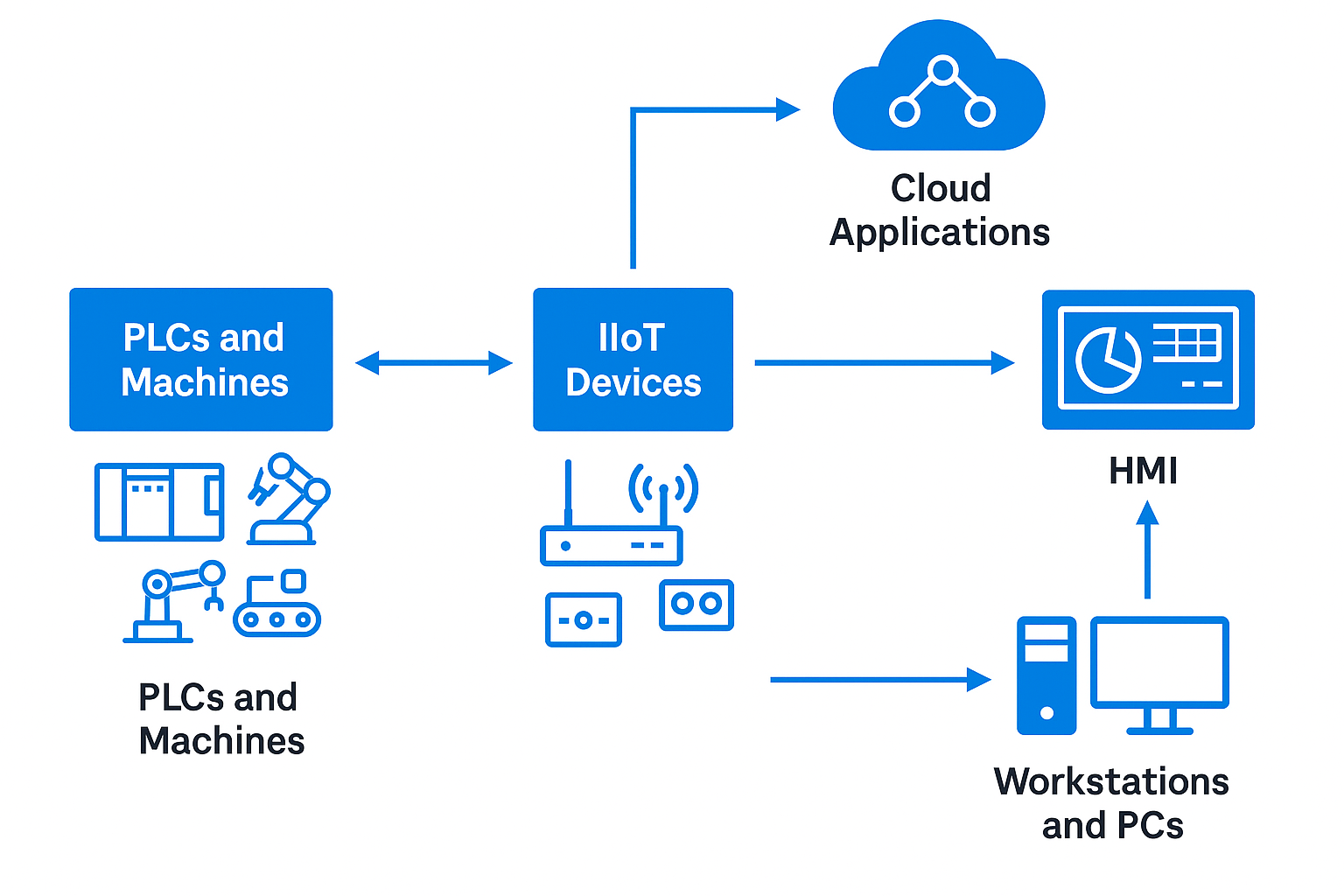
On-site PLC ➜ edge device ➜ secure transmission ➜ Cloud/local platform ➜ Web HMI + mobile device interface
📦Proposal content
✔PLC integration module
✔ Edge gateway or industrial computer
✔ SCADA/cloud monitoring platform access
✔ Exclusive customized interface design
✔ Installation and education and training services
A current monitoring system is a device or system used to monitor and record current data in real time. It is usually used in industrial, commercial or household power management to improve power usage efficiency and ensure safe operation.
Function
The main functions of the current monitoring system include:
Real-time monitoring:Accurately measures current and provides instant data.
Data record:Store historical data for analysis and tracing.
Alarm function:Sounds an alarm when the current is abnormal to prevent malfunction or danger.
Energy management:Help users understand power usage and achieve energy-saving goals.
components
Current monitoring systems usually consist of the following parts:
sensor:Such as current transformer, used to measure current.
Data processing unit:Collect, process and store current data.
Communication module:Transmit data to the monitoring platform or remote device.
Display interface:Such as LCD screen or software interface, used to display current status.
Application scope
Current monitoring systems are used in a wide range of applications, including:
Industrial production:Monitor the operating status of mechanical equipment to prevent overload or failure.
Power distribution:For load monitoring and distribution optimization of power networks.
Construction management:Manage energy use in commercial or residential buildings to achieve smart energy savings.
Renewable energy:Monitor power generation from solar or wind energy equipment.
Advantages
Advantages of current monitoring systems include:
Improve security:Detect overload or short circuit conditions in time to avoid power accidents.
Save energy:Help users identify high-energy-consuming equipment and optimize energy distribution.
Improve efficiency:Reduce downtime and maintenance costs with real-time monitoring.
Data analysis support:Provide data basis for energy management and decision-making.
future development
Future development directions of current monitoring systems include:
Intelligent:Integrate artificial intelligence and machine learning to provide more accurate predictions and automated control.
IoT integration:Linked with IoT devices to achieve more comprehensive power management.
Low power consumption design:Develop more energy-efficient monitoring equipment to reduce operating costs.
Multifunctionality:Combined with multiple parameter monitoring such as voltage and power, it provides more complete power data.
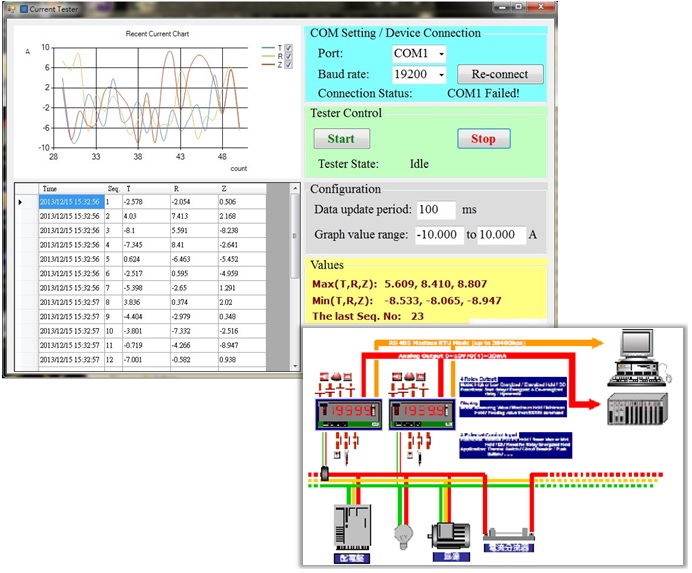
Current monitoring system: The core software cooperates with various digital meters to achieve various application systems for monitoring current.
ADtek cs2 series galvanometer
Ranging monitoring system
definition
The ranging monitoring system is a tool for accurately measuring distances. It is often used to monitor object positions, distance changes and environmental conditions in real time. It is suitable for a variety of industrial, construction and transportation application scenarios.
Main functions
The main functions of the ranging monitoring system include:
Real-time measurement:Accurately monitor target distance and provide real-time data.
Abnormal alarm:Trigger an alarm when the distance exceeds the set range.
Data record:Save measurement data for subsequent analysis.
Remote management:Support remote monitoring and parameter adjustment.
Application scenarios
The ranging monitoring system can be widely used in the following scenarios:
Industrial automation:Monitor the distance and position of objects on the production line.
Logistics management:Detect the position and spacing of goods during transportation.
Transportation system:Monitor the distance between vehicles in real time to improve driving safety.
Building survey:Used for structural distance detection and construction accuracy control.
Technical features
The ranging monitoring system has the following technical characteristics:
High-precision measurement:Achieve millimeter-level accuracy using laser, ultrasonic or radar technology.
Multi-environment adaptability:Suitable for complex environments such as high temperature, low temperature or strong light.
Data integration:Can be seamlessly connected with other control systems or data platforms.
Low power consumption design:Extend equipment life.
Advantages
The main advantages of this system include:
Efficiency:Quickly capture distance changes and improve work efficiency.
Security:Reduce surprises through precise monitoring.
Versatility:Suitable for a variety of industries and applications.
Ease of use:The user-friendly interface facilitates operation and maintenance.
future development
The future development directions of ranging monitoring systems include:
Intelligent:Combined with AI to achieve autonomous analysis and prediction.
Wireless:Improve system deployment flexibility and mobile performance.
Multi-module support:Integrate different ranging technologies to deal with complex scenarios.
Visual analysis:Provide more intuitive data display and report generation.
Ranging monitoring system: The core software cooperates with various ranging sensors to monitor the stability and abnormal status of various precision mechanical movements and other application systems
OMRON ZX series laser displacement sensor, Keyence laser displacement sensor
Semiconductor wafer arm motor monitoring system
definition
The semiconductor wafer arm motor monitoring system is a dedicated solution for monitoring the operating status of the motor of the wafer transfer arm in semiconductor manufacturing equipment to ensure its stability and accuracy, improve production efficiency and reduce the risk of failure.
Main functions
The main functions of the system include:
Real-time monitoring:Continuously monitor the motor's operating speed, position accuracy and temperature.
Abnormal warning:Detects operating anomalies such as overload, vibration or excursion and issues an alarm.
Data record:Record motor operation data to support tracking and analysis.
Diagnostic functions:Provides motor health assessment and maintenance recommendations.
Remote management:Supports remote viewing of motor status and adjustment parameters.
Application scenarios
The system is suitable for a variety of semiconductor manufacturing processes, including:
Wafer handling:Monitor the operating status of the wafer transfer arm to ensure accurate placement.
Lithography and Etching:Monitor wafer positioning and transfer within equipment.
Packaging test:Ensure smooth transfer of wafers from processing to testing.
Advantages
Advantages of the semiconductor wafer arm motor monitoring system include:
High precision:Ensure the stability and accuracy of the wafer transfer process.
Reduce failure rate:Reduce equipment downtime with predictive maintenance.
Data-driven decisions:Use data analytics to optimize production efficiency.
Automated integration:Seamless integration with production line automation systems.
Technical features
The system includes the following technical features:
High-precision sensor:Monitor various parameters of motor operation.
AI algorithm:Realize intelligent analysis and abnormal prediction.
Visual interface:It is convenient for users to view data and reports in real time.
Modular design:Conveniently compatible with different types of arm equipment.
future development
Future development directions of the system include:
Intelligent upgrade:Improve the accuracy of fault diagnosis through machine learning.
Higher compatibility:Supports more types of motors and equipment.
Cloud integration:Realize centralized monitoring and management of global production lines.
Energy efficiency optimization:Develop energy-saving features to reduce motor operating power consumption.
Semiconductor wafer arm motor monitoring system:
NSK ES/EL/EDC series motor monitoring, AMAT VHP Robot arm monitoring, PRI Robot arm monitoring
technology
IoT
definition
The Internet of Things (IoT) is a technology that connects physical objects through sensors, software and networks to achieve data exchange and automated operations. It combines the physical world with the digital world to promote intelligent applications.
core technology
The core technologies of IoT include:
Sensing technology:Collect data through various sensors, such as temperature, humidity, location, etc.
Communication technology:Use Wi-Fi, Bluetooth, 5G and other technologies to transmit data.
cloud computing:Process and store data on the cloud platform to achieve instant analysis and management.
Big data analysis:Use data analysis tools to extract valuable information from large amounts of data.
Application scenarios
IoT is widely used in many fields:
Smart home:Control smart lights, air conditioners, home appliances and other equipment to improve living comfort.
Smart city:Optimize traffic management, energy distribution and public safety.
Industrial Internet of Things:Improve production efficiency and equipment maintenance efficiency.
Health care:Monitor patient health status and provide remote medical services.
Advantages
The main advantages of IoT include:
Improve efficiency:Improve work efficiency through automated operations and data analysis.
Cost Savings:Real-time monitoring and predictive maintenance reduce operating costs.
Improve life:Provide convenient intelligent services and enhance user experience.
Data insights:Help enterprises make accurate decisions through big data analysis.
challenge
The development of IoT faces the following challenges:
Security Question:Devices are vulnerable to hackers and data privacy protection becomes a problem.
Insufficient standardization:There is a lack of unified protocols and standards between different devices.
Data management:Processing and storing massive amounts of data requires powerful infrastructure.
High cost:Equipment deployment and maintenance costs are high.
future development
The future development directions of IoT include:
Greater interoperability:Unify communication protocols to achieve seamless connections between devices.
Stronger security:Develop more advanced encryption technologies and protective measures.
Artificial Intelligence Integration:Combined with AI technology, smarter automation and predictive analysis can be achieved.
Energy efficiency improvements:Develop low-power devices and sustainable energy solutions.
Industrial Internet of Things (IIoT)
definition
Industrial Internet of Things (IIoT) is an application of the Internet of Things (IoT) in the industrial field. Through the connection and data exchange of sensors, devices, machines and systems, functions such as smart manufacturing, automated production and remote monitoring are realized.
core technology
Sensors and Actuators
Edge computing and cloud platform
Industrial communication protocols (such as Modbus, OPC UA)
Artificial Intelligence and Machine Learning
big data analysis
Cyber Security and Authentication
Application scenarios
smart factory
Equipment predictive maintenance
Energy management and optimization
Supply Chain and Logistics Tracking
Remote monitoring and control
advantage
Improve production efficiency and automation
Reduce failure rates and maintenance costs
Instant data visualization and decision support
Promote digital transformation of enterprises
challenge
Data security and privacy risks
Difficulties in system integration and standardization
High initial investment cost
Employee skills transformation needs
SCADA system
definition
SCADA (Supervisory Control and Data Acquisition) is a computerized system for remote monitoring and control of industrial processes. It monitors, collects and analyzes data in real time, helping operators effectively manage large or dispersed facilities.
Main components
Human Machine Interface (HMI):Provides a platform for operators to interact with the system, displaying data and graphical images.
Programmable Logic Controller (PLC) and Remote Terminal Unit (RTU):Used to control field devices and collect data.
Communication network:Responsible for transmitting data and instructions, including wired and wireless technologies.
Database server:Store historical data for analysis and reporting.
Application areas
Power systems (e.g. substation automation)
Water resources management (such as water plants, sewage treatment)
Oil and Gas
Manufacturing and Automated Factories
Traffic and Transportation Systems
Main functions
Real-time data monitoring
Remote control and operation
Alarm and event logging
Historical data analysis
Report generation and trend analysis
advantage
Improve production efficiency and reliability
Immediate response to abnormal conditions
Reduce manpower and operational errors
Improve decision quality
challenge
Information security risks (such as hacking)
System integration complexity is high
Initial construction costs are higher
PLC data collection and remote monitoring solution
PLC data collection principle
PLC (Programmable Logic Controller) reads signals from sensors, switches and other devices through its input module, and outputs control instructions to motors, solenoid valves and other equipment based on internal logic operations. Data collection is carried out through the following methods:
Read module input signal (digital/analog)
Record state transitions, events and counts
Temporarily store variables through internal memory (such as D area, M area)
Support data history storage (depending on PLC model)
Common information communication methods
Modbus RTU/TCP:Standard communication protocol widely used between devices
OPC UA/DA:For integration with upper-level systems (such as SCADA, MES)
Ethernet/IP、Profinet、CC-Link:Choose according to different brands and systems
PLC architecture remote monitoring solution
Remote monitoring solutions usually include data collection, transmission, visualization and control. The main architecture is as follows:
1. Field layer
PLC is connected to on-site sensors and actuators
Equipped with communication modules (such as Ethernet, RS-485)
2. Edge layer
Edge Gateway or embedded industrial computer
Convert protocols and preprocess data (filtering, aggregation, encryption)
3. Transport layer
Wired network (LAN, VPN) or wireless network (4G/5G, Wi-Fi)
MQTT, HTTP, WebSocket and other communication protocols
4. Platform layer
SCADA or cloud platform (such as AWS IoT, Azure IoT Hub)
Provide real-time monitoring screen, alarm, data history query, report analysis
5. Operation layer
Control and query via Web HMI, mobile APP, remote desktop, etc.
Application scenarios
Remote monitoring of factory equipment operating status
Machine failure early warning and real-time notification
Energy usage monitoring and analysis
Monitoring of remote sites such as drone rooms, water towers, and pumping stations
HMI graphic control software
definition
HMI SCADA Software is a software tool used to design and run human-machine interfaces (HMI). It supports the creation of graphical operation screens, connection to industrial equipment, real-time data display, alarm management and historical record query. It is commonly used in industrial automation and production monitoring systems.
Main functions
Graphical screen design (flow chart, control interface)
Real-time data monitoring and updates
Alarm settings and event logging
Historical data recording and query
Multiple communication protocols support (such as Modbus, OPC)
User permissions and security control
Common applications
Automated control and monitoring of manufacturing plants
Energy systems (e.g. water treatment, power distribution)
Building Management System (BAS)
Transportation and Public Transport Systems
Mainstream software brands
Siemens WinCC
Schneider EcoStruxure Operator Terminal Expert
Rockwell FactoryTalk View
Wonderware InTouch (AVEVA)
Ignition by Inductive Automation
MCGS, KingView
advantage
Highly visual and instant feedback
Supports multiple platforms (PC, tablet, Web)
Simplify operating procedures and improve production efficiency
Facilitates problem analysis and preventive maintenance
challenge
System integration and communication knowledge required
Project development requires a lot of time and cost in the early stages of development
Compatibility across platforms and different devices needs to be verified
Regular updates and maintenance are required to ensure system security
Manufacturing Execution System (MES)
definition
Manufacturing Execution System (MES) is an information system that connects the enterprise layer (such as ERP) and the field control layer (such as PLC). It is responsible for managing and monitoring various resources, activities and data in the production process to improve manufacturing efficiency and quality.
Main functions
Production scheduling and order issuance
Job tracking and recording
Quality management
Equipment management and maintenance
Working hours and personnel management
Data collection and report analysis
Architecture level
Enterprise level (ERP): planning and resource management
Manufacturing Execution Layer (MES): On-site execution and control
Achieve production transparency and real-time monitoring
Improve product quality and consistency
Reduce downtime and waste
Support continuous improvement and lean production
Integration challenges
Difficulty integrating with legacy systems
The import cost is high and the cycle is long
Requires high degree of customization to match the process
User training and culture change
MQTT
MQTT (Message Queuing Telemetry Transport) is a lightweight communication protocol that is particularly suitable for Internet of Things (IoT) applications and is designed for messaging between devices in low-bandwidth or unstable network environments.
Features of MQTT
Lightweight:The protocol is simple and suitable for devices with limited resources.
Based on publish/subscribe model:Many-to-many communication without direct communication between publishers and subscribers.
reliability:Supports different message delivery assurance levels.
Connection maintenance:Use heartbeat mechanism to maintain connection.
Basic concepts of MQTT
Broker:The proxy server is responsible for receiving and forwarding messages.
Publisher:Publisher, sends messages to topics.
Subscriber:Subscribers receive messages on a specific topic.
Topic:Topic, message classification.
QoS:Quality of service assurance level for messaging.
MQTT in Python
This example shows how to usepaho-mqttLibrary to connect to MQTT broker, publish messages, and subscribe to topics.
Install
First you need to installpaho-mqttLibrary. Can be installed via pip:
pip install paho-mqtt
Python code examples
The following is a basic example showing how to publish and subscribe to an MQTT topic.
1. MQTT publisher example
import paho.mqtt.client as mqtt

# Define the address and port of the MQTT broker
broker_address = "broker.hivemq.com" # Public broker for testing
port=1883

# Create an MQTT client instance
client = mqtt.Client()

# Connect to broker
client.connect(broker_address, port=port)

# Post a message to a topic
topic = "test/topic"
message = "Hello, MQTT!"
client.publish(topic, message)

# Disconnect from broker
client.disconnect()
2. MQTT Subscriber Example
This subscriber will listen to the same topic and print received messages.
import paho.mqtt.client as mqtt

#Callback function when the client receives the message
def on_message(client, userdata, message):
    print(f"Topic {message.topic} received message: {message.payload.decode('utf-8')}")

# Define the address and port of the MQTT broker
broker_address = "broker.hivemq.com"
port=1883

# Create an MQTT client instance
client = mqtt.Client()

#Set on_message callback function
client.on_message = on_message

# Connect to broker
client.connect(broker_address, port=port)

# Subscribe to a topic
topic = "test/topic"
client.subscribe(topic)

# Start MQTT loop to process received messages
client.loop_forever()
illustrate
MQTT client:Both examples usemqtt.Client()Create an MQTT client.
Broker:These examples usebroker.hivemq.comThis public broker. You can also replace it with your own broker address.
Posted by:The publisher connects to the broker and reports to the topictest/topicSend the message, then disconnect.
Subscribers:Subscribers connect to the broker, subscribe to the same topic, and continue to listen for messages.
Production line data monitoring and acquisition
The production line data monitoring and acquisition system is an important tool for real-time monitoring of the operating status of the production line. Through various sensors and data acquisition equipment, the system can collect key data during the production process to improve production efficiency and quality.
Main functions
Real-time monitoring:Continuously track various production line data, such as output, speed, failure rate, etc.
Data extraction:Automatically collect and store data for subsequent analysis and reporting.
Exception alert:When the system detects an abnormal situation, it can promptly send an alarm to notify the operator.
Report generation:Automatically generate production reports to facilitate management's assessment of production efficiency.
Advantages
Improve efficiency:Quickly identify and resolve problems through real-time data monitoring.
Reduce costs:Keep abreast of production status and reduce waste of resources.
Enhance quality:Continuously monitor the production process to ensure products meet standards.
Data-driven decisions:Data-based analytics help management make smarter decisions.
Application scenarios
The production line data monitoring and acquisition system is suitable for a variety of industries, including:
Manufacturing: Monitor the production process of products in real time.
Food processing: Ensure that the production environment meets hygienic standards.
Electronics: Track assembly line efficiency and failure rates.
Automobile manufacturing: Monitor every aspect of the production process.
Summarize
Through the production line data monitoring and acquisition system, companies can effectively improve production efficiency, reduce costs and enhance product quality, providing important data support for smart manufacturing.
Edge operations
definition
Edge Computing is a technology that decentralizes data processing, analysis and storage functions from centralized cloud servers to local devices close to data sources (such as sensors, equipment or on-site gateways). Its core purpose is to reduce latency, reduce bandwidth burden and improve instant response capabilities.
How it works
Traditional cloud computing requires transmitting a large amount of data to a data center for processing, while edge computing allows devices (such as industrial gateways and edge servers) to perform preprocessing, screening and analysis, and only uploads necessary information to the cloud or SCADA system.
Main features
⏱️ Low latency:Data is processed locally and responses are faster
📉 Reduce bandwidth consumption:Only send key data to the cloud
🔐 Enhance security:Data is not easily leaked, and decentralized processing is safer
🌐 Offline fault tolerance:Continuous operation even when disconnected
Application scenarios
Industry 4.0 smart factory
Self-driving cars and smart transportation
Smart City and Public Facilities Management
Remote equipment monitoring and predictive maintenance
Real-time visual recognition (such as AI image surveillance)
Common equipment
Industrial Edge Gateway
Embedded edge server
Smart sensors have edge processing capabilities
Comparison with cloud computing
project
Edge operations
cloud computing
processing location
close to source
remote data center
Delay
Low
higher
immediacy
high
medium
Bandwidth requirements
Low
high
Suitable for the scene
Instant response, local control
Large-scale computing and data storage
future trends
With the maturity of AI, 5G and IIoT technologies, edge computing will no longer be just an assistant to the cloud, but will become the "frontline brain" at the core of smart decision-making, especially suitable for industrial applications and smart terminal scenarios that require rapid response.
digital twin
definition
Digital Twin is a technology that instantly reflects physical objects, systems or processes through digital models. It combines sensors, IoT, AI and simulation technologies to create a virtual replica that is synchronized with the physical world to monitor, analyze, predict and optimize operational performance.
Core composition
📦 Physical objects:such as machinery, plant systems, buildings or infrastructure
🔗 Sensors and IoT devices:Collect real-time data on entity operations
🧠 Digital model:Create virtual versions of simulated behavior and operational logic
🔍 Data analysis and AI:Perform status prediction, anomaly detection and optimization recommendations
Application scenarios
Industrial equipment maintenance and life prediction
Smart manufacturing process simulation and optimization
Building and Smart City Infrastructure Management
Product design and virtual testing
Simulation of complex systems such as electricity, petroleum, and transportation
Main advantages
⏱️ Real-time monitoring:Real-time tracking of equipment status and operation through virtual models
🔮 Predictive maintenance:Analyze historical data to predict equipment failures and reduce downtime
🎯 Decision aid:Provide simulation and data support to improve operational efficiency and safety
🔁 Full life cycle management:Full-stage integration and analysis from design, operation to decommissioning
Technology integration
IoT sensor technology
Edge and cloud computing
AI and machine learning algorithms
3D models and simulation tools (such as CAD, CAE)
Instant messaging protocols and data streaming (such as MQTT, WebSocket)
future outlook
Digital twins will become one of the core technologies for smart manufacturing, smart cities, and energy management, and will be gradually applied to non-traditional industries such as medical care, agriculture, and retail, forming an infrastructure that integrates virtual and physical systems (Cyber-Physical Systems) to promote comprehensive digital transformation.